Matrescence Explained: Why Many Mothers Feel Lost in Motherhood
Matrescence, Motherhood and Maternal Mental Health
First and foremost - this blog is NOT clinical advice nor is it intended to minimize PMADS or maternal mental health. In fact, it is to strengthen this conversation, expand it and bring more attention to it, from all disciplines and providers who work with Mothers.
Thanks to the recent viral marketing campaign by Peanut, more and more mothers are Googling the word matrescence.
For many women encountering the term for the first time, it feels like a revelation.
Finally, there is a word that explains why motherhood can feel so disorienting.
Why identity shifts.
Why emotions intensify.
Why life suddenly feels unfamiliar.
And this is a powerful moment.
Because when language emerges, understanding can follow.
But as matrescence enters the mainstream conversation, it is increasingly important that professionals who support mothers—therapists, coaches, birth workers, educators, and clinicians—have frameworks that expand beyond the vocabulary itself.
Because while matrescence is often presented as a simple concept, the theory behind it is anything but simple.
It is nuanced, complex, and deeply connected to both individual development and cultural structures.
And mothers deserve support that reflects that complexity.
What Is Matrescence?
The concept of matrescence, introduced by psychologist Dana Raphael and later expanded by scholar Aurélie Athan, describes the developmental transition a woman undergoes when she becomes a mother.
It is often compared to adolescence.
Just as adolescence involves profound physical, emotional, psychological, and social change, matrescence represents a similarly transformative transition into motherhood.
But while the word itself may appear simple, the lived experience of matrescence is often far more complex.
Athan describes this transition as inherently disorienting.
And that disorientation is not a problem—it is a natural part of developmental growth.
Periods of identity disruption often precede expansion.
They can lead to deeper awareness, new values, and an evolving sense of self.
In the language of liberation theory, this moment of disruption can also become a form of awakening, similar to what Bobbie Harro describes in the Cycle of Liberation.
Matrescence, at its core, holds the potential for transformation.
Why Many Mothers Feel “Lost” in Motherhood
Today, many mothers encounter the word matrescence and feel immediate relief.
“This explains it. I’m not broken—I’m experiencing matrescence.”
And in many ways, that realization is absolutely correct.
But the “lost” feeling many mothers experience today is not solely the result of matrescence itself.
It is also shaped by the social and cultural context in which women mother.
In other words, mothers are not just navigating the developmental transition of matrescence.
They are navigating Motherhood, with a capital M.
The Cultural Scripts of Motherhood
The experience of motherhood today is heavily shaped by cultural ideals such as:
the Perfect Mother Myth
intensive mothering
the expectation that a “good mother” prioritizes her children above all else
These narratives ask mothers to center their identities entirely around caregiving.
Over time, these expectations can subtly communicate that in order to be a “good mother,” she must slowly erase herself.
Her needs.
Her ambitions.
Her individuality.
This is not matrescence.
This is cultural pressure.
And when these pressures become internalized, they can significantly impact maternal mental health.
Understanding the Difference: Matrescence vs. the Impact of Motherhood
For professionals supporting mothers, it is critical to distinguish between:
Matrescence (a developmental transition)
The cultural and structural pressures of Motherhood
While they interact deeply, they are not the same.
Understanding this distinction can help ensure we do not:
over-pathologize mothers, or
minimize the real challenges they face
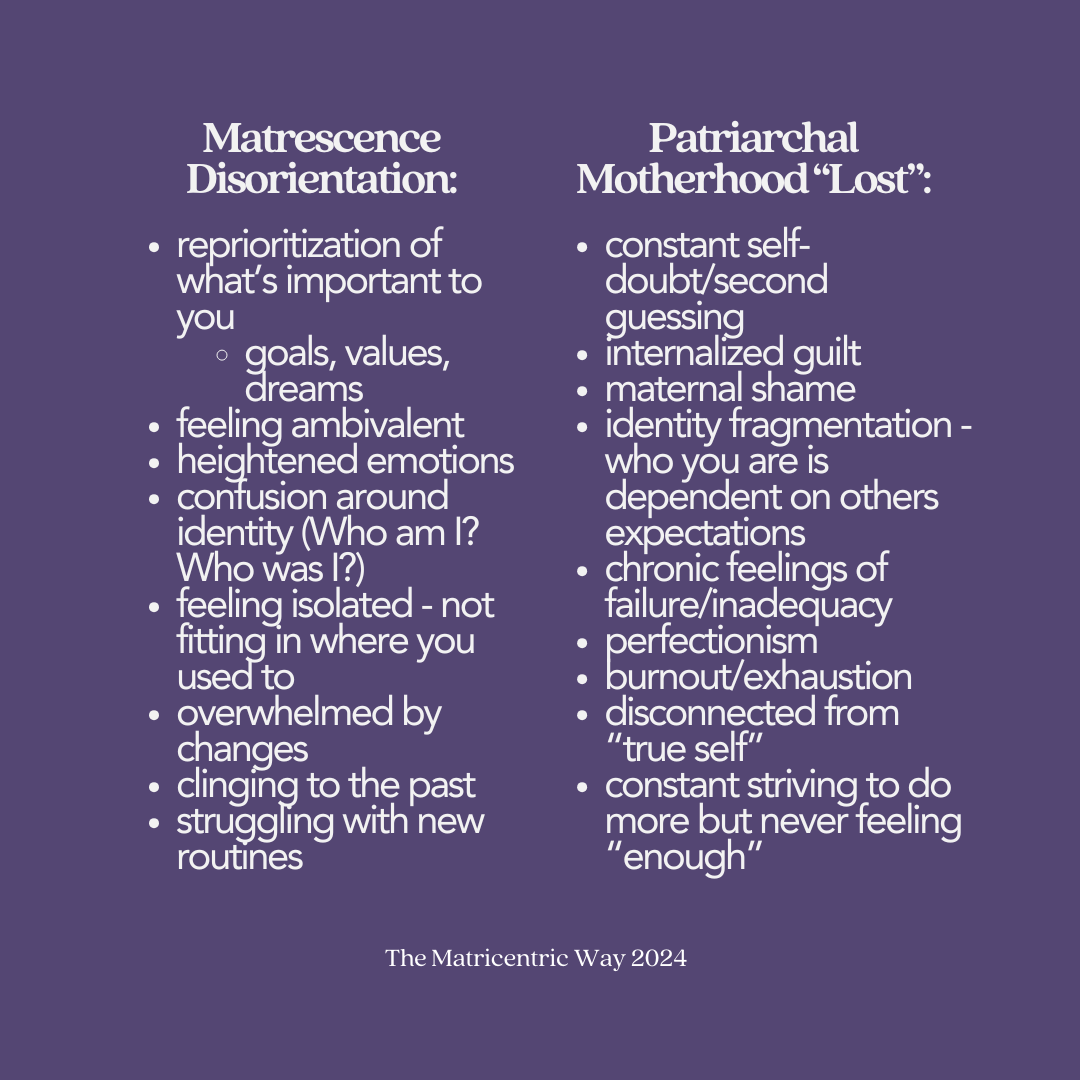
Below are two ways these experiences often show up.
What Matrescence Disorientation Can Look Like
The developmental push often includes experiences such as:
reprioritizing what matters most
shifting goals, values, and dreams
feeling emotionally heightened or more sensitive
experiencing ambivalence about motherhood
confusion around identity (Who am I now? Who was I before?)
feeling disconnected from previous social circles
struggling to adjust to new routines
longing for aspects of life before motherhood
feeling overwhelmed by rapid life changes
These experiences reflect the growth and identity restructuring that occurs during matrescence.
Disorientation is often part of transformation.
What the Impact of Motherhood Can Look Like
In contrast, the cultural pressures surrounding motherhood often manifest as:
constant self-doubt and second-guessing
internalized guilt
maternal shame
identity fragmentation (who you are becomes dependent on others’ expectations)
chronic feelings of inadequacy or failure
perfectionism
burnout and exhaustion
disconnection from one’s authentic self
constant striving to do more, while never feeling like it is enough
These experiences are often responses to external expectations placed on mothers.
Where Maternal Mental Health Fits In
It is also within this space that PMADs (Perinatal Mood and Anxiety Disorders) and other maternal mental health challenges may emerge.
These conditions can include:
postpartum depression
postpartum anxiety
postpartum OCD
birth trauma
and other mood disorders
For professionals supporting mothers, developing the ability to differentiate between developmental transition, cultural pressure, and clinical mental health concerns is essential.
Without this distinction, we risk two common mistakes:
Over-pathologizing mothers for normal developmental experiences
Minimizing serious mental health challenges that require care
Mothers deserve support that recognizes both the complexity of matrescence and the real structural pressures shaping their experience.
Why Professionals Need Frameworks for Supporting Matrescence
As matrescence becomes more widely recognized, simply knowing the word is no longer enough.
Mothers need professionals who understand the deeper layers behind the concept.
They need practitioners who can recognize:
the developmental transformation of matrescence
the cultural narratives shaping motherhood
the structural pressures influencing maternal identity
and the mental health challenges that may emerge within her maternal lifespan (intersecting with both matrescence AND Motherhood)
Matrescence may be a single word.
But within it lives an entire landscape of identity development, cultural expectation, and psychological transformation.
And mothers deserve professionals who are equipped to navigate that landscape with them.
Interested in reading more? I recently contributed to Jessie Harrold’s collection “Mother Becoming: Reflections and Scholarship on Matrescence” and you can read my piece “Differentiating Between PMADs and Matrescence: A Critical Examination of Maternal Development and Its Pathological Interpretations” available for purchase here.
Learn More and Get Involved
Professionally: The Matricentric Way is leading this paradigm shift - it truly is expanding the conversation on maternal mental health. If you are a professional that supports Mothers, I invite you to enroll in The Matricentric Way, either LIVE or self-paced. Join this movement today so that we can transform not only the lives of the individual Mothers we support, but the greater collective of Mothers.
Additionally, Matrescence, Motherhood and Maternal Mental Health Clinical Consultation is offered monthly for therapists seeking to expand their understanding of this unique intersection. Learn more here.
Personally: The Becoming Mama course is available self-paced for any Mother within her first 7 or so years postpartum, interested in learning more about her matrescence AND the impact of Patriarchal Motherhood on her experience of being a Mother. (NOTE: this is NOT a substitute for clinical therapy NOR is it recommended to treat maternal mental health challenges. Consult your therapist for any mental health concerns.)
Download the CARE Model – Start the shift with our free introduction guide to dismantling the mental load and re-imagining care.
Purchase The CARE and HOLD Model for Professionals here. And if you are interested in this model personally, you can purchase the Guide here.